What is Bitcoin Staking on Stacks?
It is a protocol-bond model for earning BTC-denominated yield from Stacks miner activity. The self-custodial path locks BTC on Bitcoin L1 for the bond term and pairs it with an STX position.
Bitcoin Staking on Stacks is live.
Learn how BTC holders can earn Bitcoin-denominated rewards through Stacks.
A practical guide to Bitcoin Staking on Stacks: mechanics, rewards, bonding periods, STX requirements, risks, and participation.
Start Earning


Bitcoin Staking on Stacks lets eligible BTC positions earn BTC-denominated rewards through Proof of Transfer. The self-custodial path keeps BTC timelocked on Bitcoin L1.

Bitcoin Staking

Hold sBTC & boost with STX Stacking or DeFi

STX Stacking
Current target: ~3% BTC APY during bootstrap; realized rewards can vary.
Read FAQ to learn how the boost economics workHow does Stacks Bitcoin Staking work?
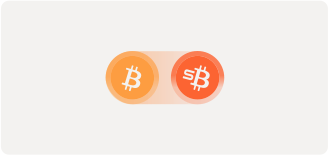
Self-custodial Bitcoin Staking locks BTC on Bitcoin L1 for the bonding term and pairs it with STX. The BTC does not need to be bridged or wrapped on this path.
Go to sBTC Bridge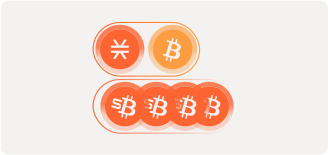
The STX position supports the protocol bond and determines capacity. STX Stacking is a separate Stacks consensus activity that earns BTC from miner commitments through Proof of Transfer.
Learn more about Stacking
Use your sBTC across Stacks protocols while still
earning rewards. Your sBTC works in DeFi and
earns yield simultaneously.
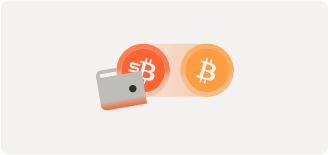
All rewards distributed in sBTC, redeemable 1:1 for
BTC anytime.
















sBTC is secured by a decentralized signer network using threshold-signature consensus. Signers can only co-sign smart contract-defined transactions.

Since December 2024, the Signer network has processed real Bitcoin transactions collectively, removing single-operator risk.

Deploy sBTC across Stacks protocols while earning Dual Stacking rewards. Put your bitcoin to work in DeFi and keep earning —without relying on custodians.

Stacks is the only blockchain with Proof of Transfer — a consensus mechanism that directly channels Bitcoin from miners to participants who secure the network.
Dive into the technicals
As of October 4, 2026, Bitcoin Staking on Stacks is in its live bootstrap phase. The Genesis Bond launched on September 10, 2026. In its first 14 days, participants bonded 230 BTC alongside 3.57M STX and received 0.28 BTC in rewards. Bonding Period 2 is scheduled to open October 10, 2026 with 500 BTC of capacity.
It is a protocol-bond model for earning BTC-denominated yield from Stacks miner activity. The self-custodial path locks BTC on Bitcoin L1 for the bond term and pairs it with an STX position.
Stacks miners commit BTC through Proof of Transfer. Protocol bonds receive their allocation first, with the remaining miner BTC flowing through the existing PoX reward structure.
The current target is approximately 3% APY, annualized over a Bitcoin year and paid in BTC. A six-month bond is about 1.44% at the target rate, but realized yield can vary and the target is not guaranteed.
The second bonding period is scheduled for October 10, 2026 with 500 BTC capacity. Capacity, rates and participation rules can change as the bootstrap phase develops.
STX Stacking locks STX to support Stacks consensus and earns BTC from miner commitments. Bitcoin Staking instead creates a BTC/STX protocol bond designed to pay BTC yield to the bonded BTC position.
The self-custodial route avoids a centralized custodian and keeps BTC on Bitcoin L1 under the participant's control, but it still has protocol, liquidity, STX exposure and market risks. Pooled routes have different custody assumptions.
Participation depends on the current bonding period and route. During bootstrap, direct self-custodial access is limited to approved participants, while pooled routes can provide access without the same direct-bond requirements. Verify capacity and eligibility on the official Stacks staking interface.
Yes. The current protocol-bond design pairs BTC with an STX position worth roughly 5% of the BTC position.
Rewards are distributed on Bitcoin-week cycles, approximately every 1,050 Bitcoin blocks or about seven days.